


Ribbonfish Science: 5 Fun Facts About Ribbonfish
Aug 25, 2026
Leave a message
Today we'll talk about ribbonfish, one of my country's four major marine products. Ribbonfish are also called ribbonfish, toothed ribbonfish, and in Qingdao and Rizhao, they're called "mian fish." Their bodies are silvery-gray, and their most distinctive feature is their long, flat body, even their internal organs are flattened. Ribbonfish, along with large yellow croaker, small yellow croaker, and squid, are known as China's four major marine products.
Ribbonfish Habitat
Ribbonfish are mainly distributed in warm and tropical seas worldwide and are a type of riverine fish. They typically inhabit waters 60-100 meters deep, migrating to shallower waters to spawn. Despite their small appearance, they are actually very ferocious carnivorous fish. When still, ribbonfish stand upright with their heads up, maintaining balance by moving their dorsal and pectoral fins. Once they spot prey, they bend their bodies, rapidly swing their dorsal fins, and quickly pounce on their prey. Their main diet includes krill, horse mackerel, and they even engage in cannibalism.
Nutritional Value of Ribbonfish
Ribbonfish is highly nutritious, containing protein, fat, phosphorus, iron, calcium, and vitamins B1 and B2. Although it is high in fat, it is mostly composed of unsaturated fatty acids, including DHA and EPA. DHA, commonly known as "brain gold," helps improve brain health and intelligence; EPA acts as a blood vessel cleanser, helping to prevent fat buildup in blood vessels and thus preventing cardiovascular diseases such as high blood pressure. Furthermore, a natural component called 6-thioguanine has been found in ribbonfish, which may have anti-cancer properties.
Cooking Methods for Ribbonfish
Ribbonfish is not only tender but also versatile in cooking methods, including steaming, braising, frying, pan-frying, and stewing. Different regions also have various regional specialties, such as ribbonfish wrapped in meat pies in Beijing, pan-fried ribbonfish in Shanghai, spicy ribbonfish in Sichuan, steamed ribbonfish in Zhoushan, and ribbonfish cooked in an iron pot in Northeast China.
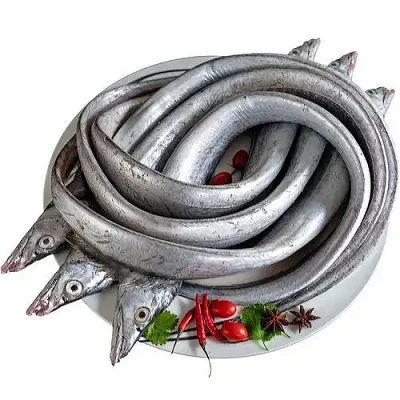
Why are ribbonfish always frozen?
It's difficult to buy live ribbonfish in the market because they generally live in waters around 60 meters deep and are accustomed to the high pressure of seawater. When ribbonfish are caught quickly, the external pressure decreases, causing the fish inside to expand rapidly due to the pressure change (similar to decompression sickness in divers), resulting in death within two hours of being brought to the surface. To avoid this, the ribbonfish would need to be placed in a professional pressurized container, which would lead to excessively high transportation costs. Therefore, ribbonfish are usually frozen immediately after being caught, which not only reduces costs but also largely preserves their taste and nutrients.
How to choose fresh ribbonfish?
First, look at the gills. Fresh fish gills are generally red, gradually turning black over time, so never buy fish with blackened gills. Second, look at the eyes. Fresh ribbonfish usually have full, protruding eyes with bright, clean white sclera; while stale ribbonfish have sunken, blurry-looking eyes. Finally, examine the fish's body and scales. Fresh ribbonfish have a silvery-white body with a relatively intact silver membrane, and the scales do not fall off easily. Unfresh ribbonfish, on the other hand, will have a yellowish surface due to oil oxidation, and the scales will fall off easily when touched.
Types of Ribbonfish
Common ribbonfish on the market are divided into yellow-eyed and black-eyed varieties, mainly depending on their origin. Black-eyed ribbonfish primarily come from northern my country, such as Zhoushan in Zhejiang and Dalian in Liaoning; while yellow-eyed ribbonfish mainly come from southern my country, such as the South China Sea. Imported ribbonfish from the Philippines are also mostly yellow-eyed. In terms of taste, black-eyed ribbonfish are smaller than yellow-eyed ribbonfish, but have more flesh and a milder fishy smell, making them suitable for steaming; while yellow-eyed ribbonfish have thicker skin, making them more suitable for braising or deep-frying.
The Future of Ribbonfish
Although ribbonfish catches have shown a downward trend in recent years, from 1.1868 million tons in 2010 to 908,500 tons in 2019, scientists are researching how to artificially cultivate ribbonfish. Because ribbonfish have a habit of migrating from deep-sea rivers to shallow-sea areas, and because they engage in cannibalism, creating a suitable habitat is very difficult. In 2017, the Zhoushan Fisheries Research Institute successfully kept ribbonfish alive in an artificial environment for more than two months, which laid a good foundation for future exploration.
