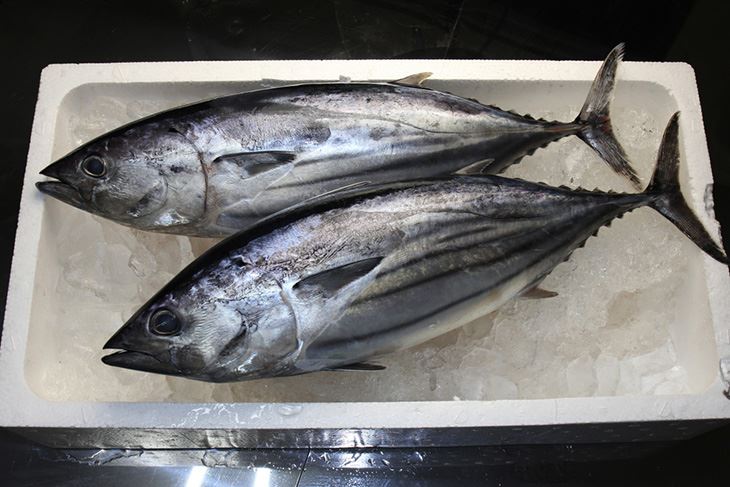
Skipjack tuna
Mar 08, 2022
Leave a message
Tuna has a mild, meaty flavour. The meat is bright red when raw and turns brown-grey when cooked.
Skipjack tuna is most commonly canned.
Biology
Scientific name: Katsuwonus pelamis
Family: Scombridae
Other names: Striped tuna, oceanic bonito
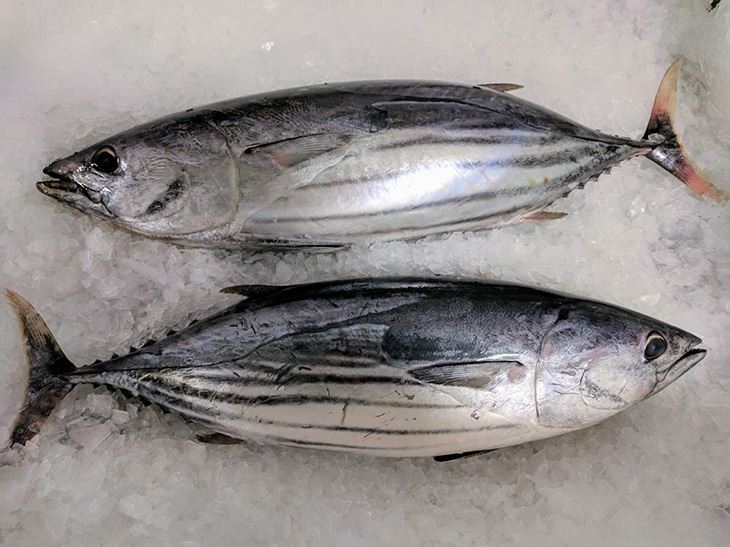
Description: Skipjack tuna have torpedo-shaped bodies with dark blue or purple backs, and silver on the lower sides and belly. They have 3-5 prominent dark bands running along the length of the lower sides. Skipjack tuna are mostly scaleless.
Size (length and weight): Up to 1.1 metres in length and 34.5 kg.
Life span: About 8‑12 years.
Habitat: Skipjack tuna are widespread throughout the tropical waters of the Pacific, Atlantic and Indian Oceans. Skipjack tuna are highly migratory and travel long distances. They are a pelagic species that can be found to depths of 260 metres. Skipjack tuna tend to school by size. Schools are often associated with albacore or yellowfin tuna, and sometimes with whales or whale sharks. Schools may also occur in association with floating objects. Juveniles are generally found in surface waters and move into deeper water as they mature.
Prey: Crustaceans, fish and squid. Cannibalism is common in larger individuals.
Predators: Larger fish such as yellowfin and bigeye tunas, and billfish.
Reproduction: Skipjack tuna reach reproductive maturity at 1‑2 years of age. They spawn throughout the year in tropical waters, and during summer and early autumn in subtropical waters. In tropical waters females spawn almost daily. Females produce 0.8‑2 million eggs per spawning season depending on their body size. Eggs hatch after 1‑1.5 days.