


Study of octopuses, squid, cuttlefish and other mollusks(A)
Jul 03, 2021
Leave a message
Study of octopuses, squid, cuttlefish and other mollusks(A)

How to tell cuttlefish, squid and octopus?
“Octopus is with eight tentacles, squid is with ten tentacles”. Does it we usually say? But it is no for sure. There are many kinds of Cephalopoda.
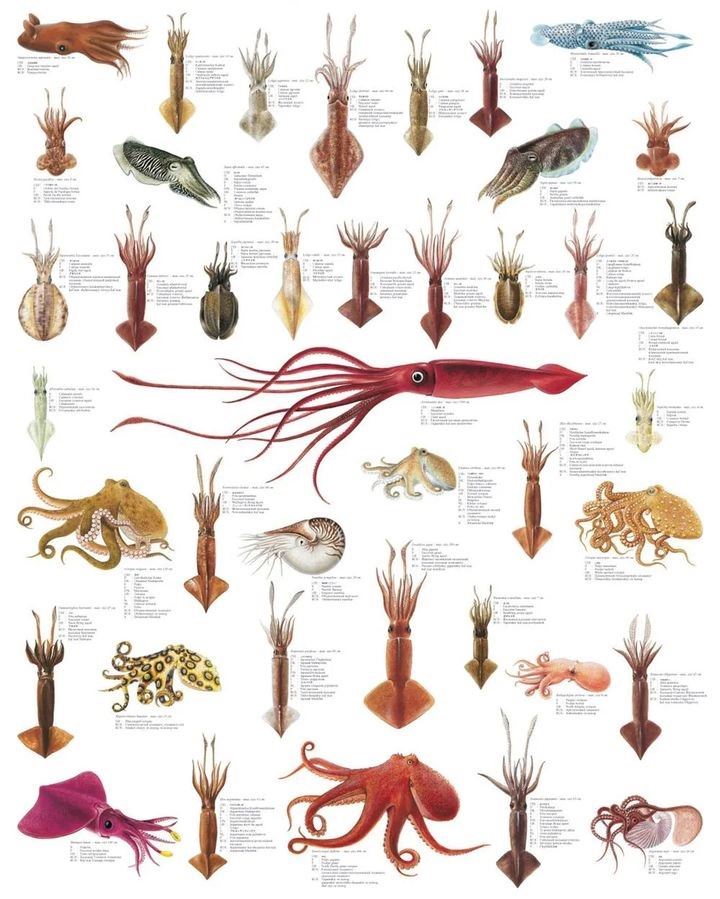
Cephalopod outline
We know that octopuses and squid are molluscs, which are the second largest animal kingdom and second only to arthropods in number of species, with names ranging from 50,000 to 120,000. From snails as small as peanuts to squid as large as whales, there are more forms than any other species. Crucially, many mollusks, such as squid and octopus, have long been an important food source for humans.
Cuttlefish and octopus belong to the class Cephalopoda, which belongs to the phylum Mollusca. They are classified in the same class as Bivalves, Polyplatidae, Digesopods, Gastropoda, etc.

There are currently two subclasses of cephalopod, Octopus Coleoidea and Nautiloidea.
The Ammonites subclass, also known as the Tetrabranchia subclass, is characterized by a spiral shell with a parrot's beak, and isometric spirals that are naturally of golden proportions, which are highly aesthetic. They usually live at a depth of 150 to 300 meters and can live for up to 20 years. Their shells are usually no more than 20 centimeters in diameter. Although its body size is small, but it in the earth's survival time is longer than the dinosaurs, so as to be known as the "living fossil of the earth". There are 5 species in existence.

Octopus does not have a shell at all, but partly has an inner shell to control the ups and downs. This subclass is also known as Dibranchia. Currently, there are 823 species of WoRMS confirmed by other authorities, and about 800 species of WoRMS confirmed by other authorities. The subclass Octopodiformes is subdivided into Decapodiformes and Octopodiformes according to the number and structure of the palpate arms.

Octocarpa is subdivided into octocarpa and phelocephala.
Only one species of octopus has been found so far -- octopus ampyroteuthis infernalis! It is also known as a Vampire Squid because its eight tentacles are linked together by a membrane that looks like a Vampire cloak with spikes on the hood and its bright red color. Ghost Octopus is not actually a squid, lacking an ink sac or ten arms, but it is an ancient deep-sea creature that is likely a common ancestor of both squid and octopus.

Octopoda
Octopoda, also known as Octopus, commonly known as Octopus or Octopus, also known as Octopus or Octopus, is called Octopus in English. Currently, there are 302 species confirmed worldwide, so they can be further subdivided into Incirrina of Aptera and Cirrina of Ptera. It should be noted that the "wing" here is not the wing of the wing, but refers to a pair of cilia-like projections (Cirri) beside each sucker on the octopus's wrist.

In addition to having unique ciliated projections, the suborder Aptera is distinguished from the suborder Aptera in that it does not have an inner shell but has flesky fins, hence the name of the suborder Aptera. The flesky fins are used to help adult octopuses swim and advance. In addition, the suborder Pteroptera does not have an ink sac, which is similar to the vampire squid.
Octopidae has 245 species of 10 families, among which the genus Octopidae accounts for the largest proportion, as high as 72 species, and there were even more before the separation of families! There are 8 common octopus species in coastal areas of China, namely, octopus verum, octopus ring, octopus short, octopus longus, octopus ovum, octopus double spot, octopus spindle and octopus Canopus.
Octopus vulgaris, also known as Common Octopus vulgaris, is a Common Octopus found in tropical and temperate waters of the world's oceans and is the most Common table guest of all mankind. Octopus minor, also known as Octopus minor, is also worth mentioning.
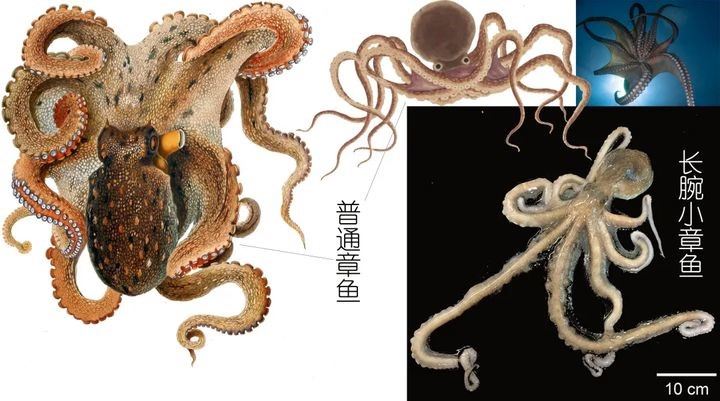
An octopus has three hearts and nine heads! Eight hands, 1,920 suckers! It will change color, camouflage and glow! Can spew black ink, but the body flow blue blood! ... The so-called nine heads, in fact, means that its neurons are not concentrated in the head, eight touch wrist also have neurons, even accounted for two-thirds, so all can function independently. So, even if you cut off the head, the wrist will still move. Eight wrists are not exactly eight hands. Two of them are mainly used for walking and the other six are used for foraging. If it is a male octopus, there is 1 special for the handover wrist. Each wrist has 240 suction cups, and these wrists are capable of regenerating.
How much adsorption is it? We can calculate: according to F=AP (P refers to atmospheric pressure), suction F=AP =2π R ²P= 0.0013M ² X 100000 Pa= 130N for a sucker with a radius of 2 cm. There are thousands of other suckers, so you can imagine how strong an octopus is.